Indeed
Redesigning Job Search for the Japanese Users
Bridging global product vision and local user behavior in Japan’s job market

Indeed | 2019-2020 | UX Designer
Vision & OKR Planning, Strategy, Concept, Design Workshop Facilitation, Research, Cross-Functional Collaboration, Rapid Prototyping, A/B Testing
Summary
As the first Japanese-speaking UX designer at Indeed—the world's #1 job site—I led a redesign of the Japan job search experience that rolled out to the entire Japan market. Despite a high volume of job listings, Japanese users browsed but hesitated to apply, signaling a mismatch between the globally standardized product and local expectations. Through in-depth research and competitive analysis, I identified the cultural and behavioral gaps driving that hesitation, then facilitated workshops, built prototypes, and collaborated across teams in Japan and the US to deliver a tailored experience. It lifted the platform's core engagement metrics—and the Japan-first design was later adopted across Indeed's US and global platforms.
Problem
Indeed is the world's largest job platform, and its Japan site draws tens of millions of job seekers every month. Yet despite this scale and a high volume of job postings, Indeed Japan saw notably low application rates compared to the US. Japanese users browsed but hesitated to apply—a signal that the platform's globally standardized experience was misaligned with local expectations.
My Role
I owned the design end-to-end—from vision planning and workshop facilitation to prototyping and final design for implementation—under the guidance of my design manager. I partnered with a product manager, a UX researcher, a Design Technologist, and 5–6 engineers, as well as design system and product teams in the US.
Competitive Analysis
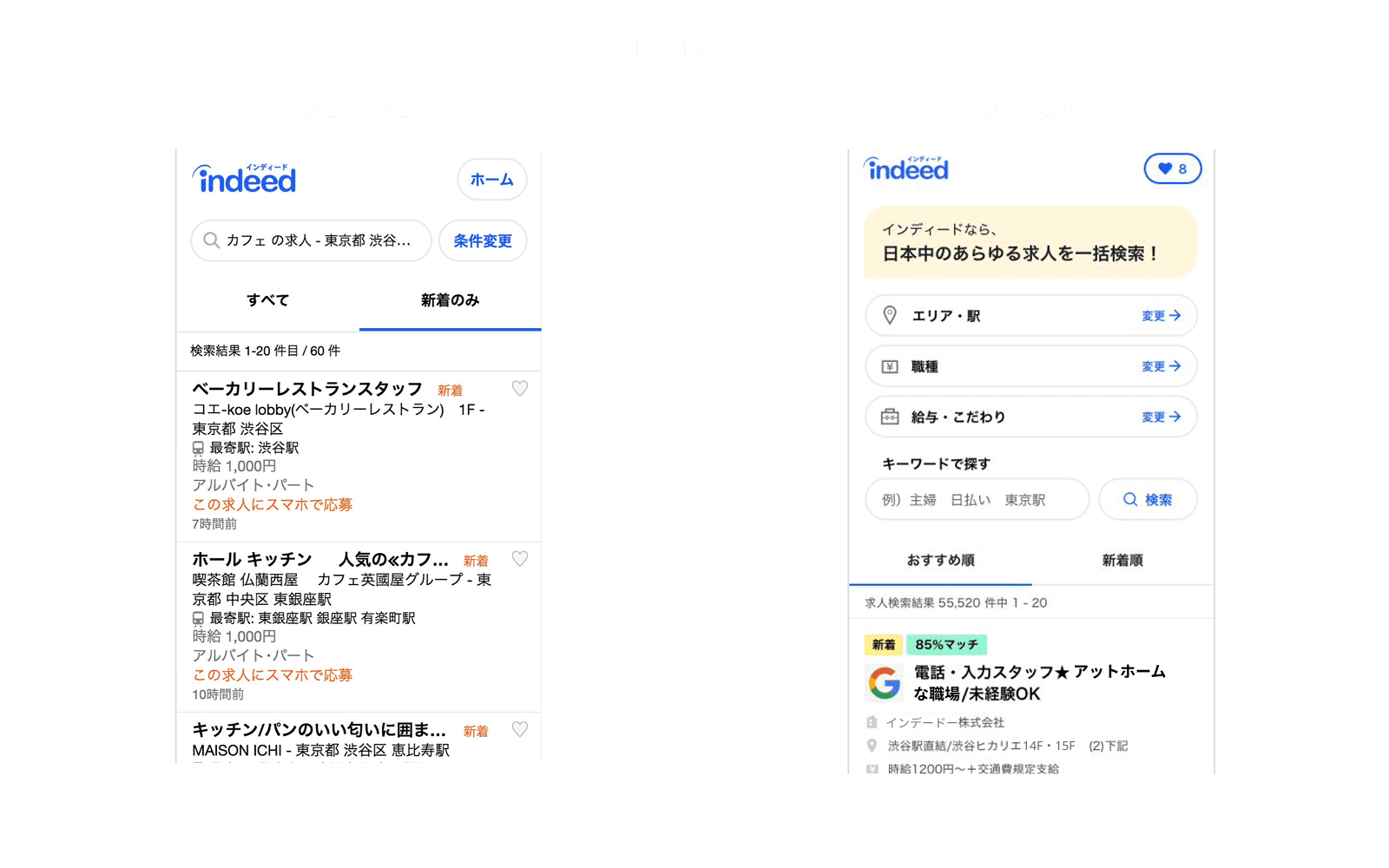
I conducted a competitive UX audit of job search platforms in Japan and uncovered key differences:
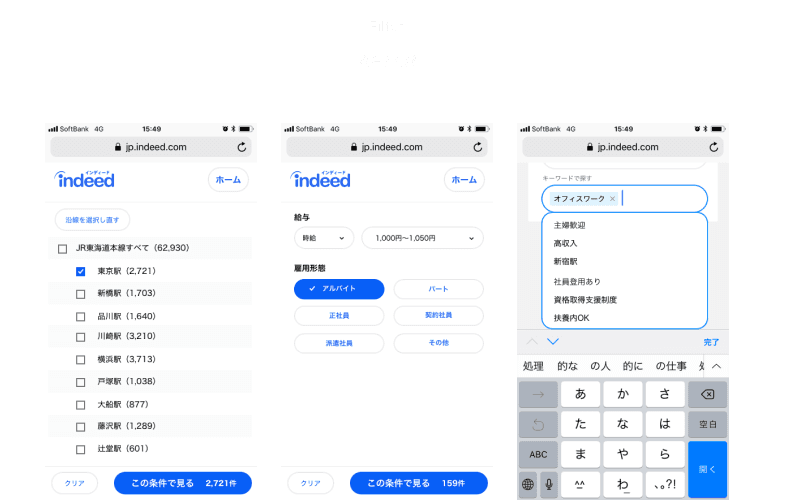
Competitors offered multi-criteria filters, while Indeed relied on a single search box.
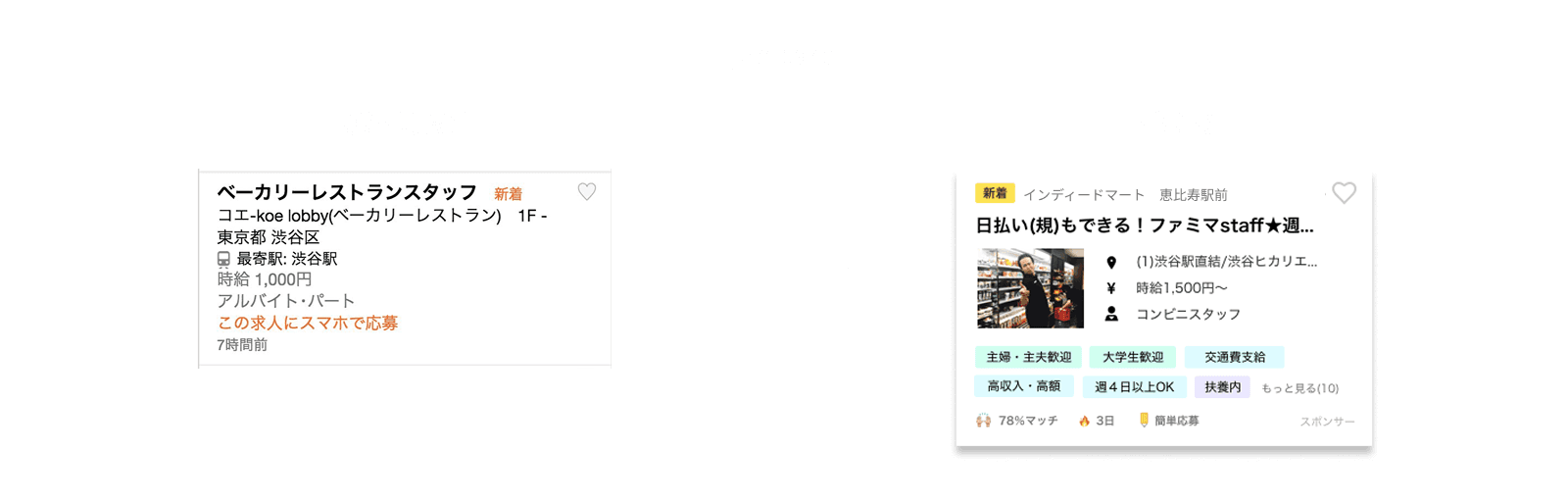
Japanese platforms used structured content with visual elements, such as photos and icons.
Indeed’s text-heavy layout and minimal filtering clashed with Japanese users’ desire for clarity and context.
Japanese users wanted to understand working environments quickly, without reading long paragraphs.
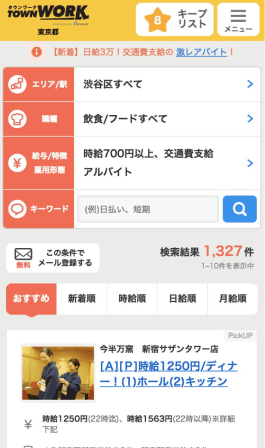
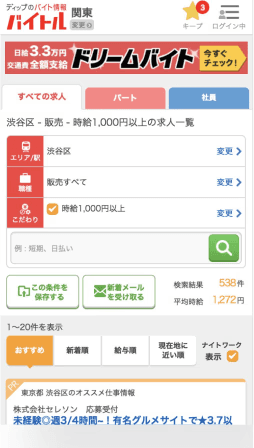
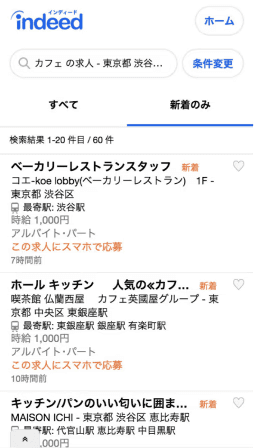
Competitors (left, center) had more colors, icons, photos, filters, whereas Indeed had simple texts and minimum colors only.
Discovery Research
We conducted interviews with part-time job seekers to understand their motivations, behaviors, and challenges. Key findings included:
Many users prioritized flexible hours, short commute times, or earning pocket money.
Others sought jobs to connect with society after retirement or child-rearing.
Job search was often brief and purposeful—users expected a streamlined, goal-oriented flow.
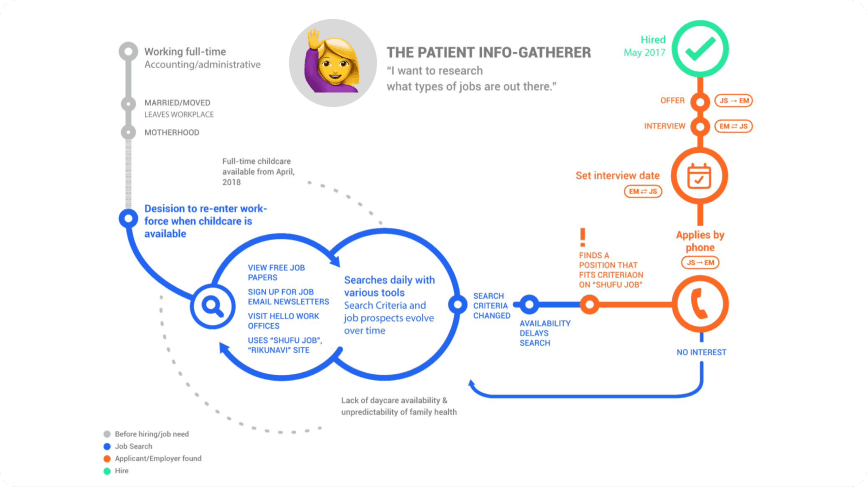
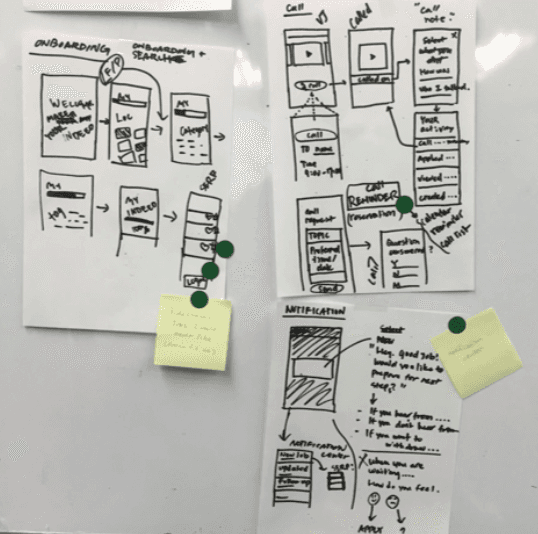
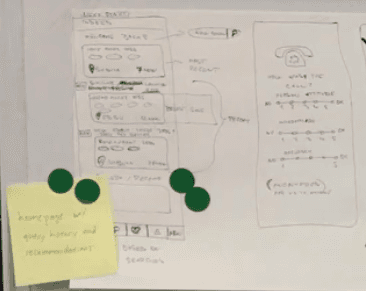
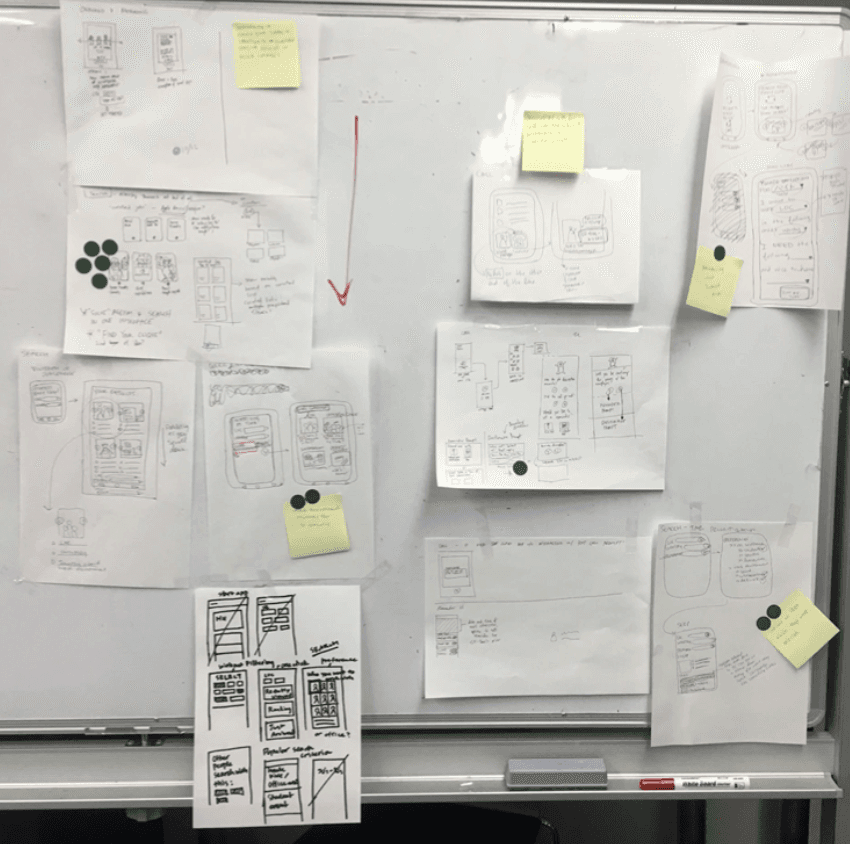
We created archetypes based on research and mapped their search journeys. This clarified key moments of frustration and opportunity in the job search process.
Prototyping & Design System Integration
I translated workshop ideas into low-fidelity prototypes and collaborated with a Design Technologist on high-fidelity versions. Design key points were:
Structured information
Job highlights
Visuals (photos, icons, etc)
I also incorporated Indeed’s newly developed design system in prototypes to evaluate compatibility with Japanese users’ expectations.

User Research
Multiple rounds of user interviews showed the new design aligns with user expectations better.
"Photos are helpful for understanding the workplace environment."
"I prefer reading bullet points over paragraphs."
"This version makes it easier to decide whether to apply."
Prioritization & Engineering Collaboration
The redesign required significant engineering investment—the ideal experience was far more than could be built in a single release. Rather than hand finished designs to engineers, I worked with them from the start: facilitating workshops, walking through each proposed change, and explaining not just what was needed but why it mattered for users.
Together, we broke the redesign into discrete features and evaluated each through three lenses—business impact, UX priority, and engineering effort. This shared framework let us sequence the work as a phased rollout rather than one large build. Surfacing workplace photos and restructuring how job information was presented, for example, were scoped as separate features and shipped in different phases—each sequenced by its own impact and effort—so the highest-value, most feasible improvements landed first.
I owned the UX priority lens in these discussions, advocating for the changes that mattered most to users and grounding those arguments in research. The final sequencing was a team decision, reached by consensus across design, product, and engineering. Aligning three different definitions of "important" into a single roadmap is itself a design problem—and learning to do it well shaped how I approach cross-functional work today.
MVP
I delivered an MVP design that balanced technical feasibility with user-centered improvements, including:
Scannable job descriptions
Search filter
Job card
I also consolidated user feedback and shared it with the US design system team and external partners.

Impact
Following a phased, A/B-tested rollout, the redesign reached 100% of the Japan market and delivered a measurable, statistically significant lift in the platform's core engagement metrics—apply rate and saved-jobs rate.
100%
rollout across the Japan market
Global
Japan-first design later adopted by Indeed's US and other markets
2019
Indeed Engineering Innovation Award
Ongoing Iteration
I continued iterating on the job description while expanding the project scope to include:
Search filters
Personalized job feed
Improvements for native mobile app
Global Influence
The redesign began as a Japan-specific solution—but the underlying principles proved universal. Indeed later adopted the Japan-first design direction across its US and other global markets, reshaping the job search experience for a platform used by hundreds of millions of people worldwide. A redesign born from local user research ended up influencing the global product.
Sharing Insights Externally
I wrote about the design process in an article published on the Indeed Design Blog:
Beyond Localization – Customizing Indeed for Job Seekers in Japan
What I'd Do Differently
The redesign measurably improved the experience and rolled out across the Japan market—a result I stand behind. But with hindsight, I also hold two honest limits in view.
The first is the metric. The redesign lifted apply rate—but apply rate is a slippery thing to optimize. It measures the apply click—intent, not a completed application, and not whether someone found a job that fit—and it can even point the wrong way: more clicks might mean confidence, or might mean users can't tell which role is right and are applying scattershot. The outcome we actually wanted was harder to measure: the right job, found and applied to with little effort. Measuring even that well had limits I couldn't remove here—the application flow was outside this project's scope (redesigned later, as separate work), and as an aggregator, Indeed often hands users to third-party sites where the true outcome stays hard to see. The redesign moved the number it was set up to move; what stayed with me afterward was how much that number leaves unsaid.
The second is the design itself. Under pressure to show results quickly, and leaning on competitive analysis and A/B testing, the redesign converged toward patterns users already recognized from other job sites. It cleared the bar of measurably better and competitive—but it didn't reach a genuinely new experience that made job searching meaningfully easier for Japanese users. The company's understanding of the Japanese user was still maturing at the time, and familiar convention quietly filled that gap.
Neither limit takes away from what the redesign achieved—but together they shaped how I work now. I pay closer attention to what a metric does and doesn't capture, and I treat "measurably better than before" as a floor, not a finish line—protecting room for the bolder, harder-to-measure bet, and for the deep local user understanding that competitor patterns too easily replace. I've come to see that part of a designer's job is to help the team see the gap between a convenient proxy—a metric, or a competitor's pattern—and the real user outcome, so the proxy stays a useful guide rather than quietly becoming the goal.
Copyright©2026. Mikako Matsunaga